
No Blueprint, Groundbreaking: The Remarkable Career of Sheila Johnstone

Updated: Sep 2

The Question That Started It All
In an eighth-grade science class in St. Louis, a girl named Sheila raised her hand and asked her teacher something nobody had thought to ask. Pointing to a brain preserved in a jar of formaldehyde on the desk, she asked, “Is that a male brain or a female brain?”
Her teacher, Miss Steideman, laughed. She had no idea, she said. It would depend on the size of the person it came from. Males and females both had the same brain.
That answer landed differently than Steideman may have intended. At the school Sheila Johnstone (née Stuhlbarg) attended, girls were not called on in class, even in honors courses. In the 1950s, boys were expected to pursue higher education, while girls were not.
But if the brain was the same, Johnstone reasoned, maybe women were meant to use theirs for something beyond society’s script.
In Johnstone’s day, women were not supposed to become molecular biologists. She became one anyway, her curiosity and determination shaping every chapter of a life with more chapters than most.
Johnstone began her academic career in biology and medical technology, drawn to the precision of science and the discipline it required. But she did not stay in a single lane.
Later, she pursued an English degree from Florida International University, developing a parallel skill set that would prove just as essential: the ability to read closely, write clearly, and recognize what had been left unsaid.
The combination of scientific rigor and language wasn’t something she set out to engineer. It emerged over time, shaped by opportunity, instinct, and a refusal to ignore what she could do well. The pattern repeats throughout her life. Johnstone often returns to a Branch Rickey line a Washington University colleague liked to quote: “Luck is the residue of design.”
Twenty Years in Medical Research
Johnstone spent two decades in academia, splitting 10 years each at Washington University Medical School in St. Louis and the University of Miami. Her work spanned pharmacology, dermatology, and biochemistry, but the project that has stayed with her most was a collaboration with Dr. Jean Holowach at St. Louis Children’s Hospital.
They were trying to save children who were dying from aspirin intoxication. At the time, the standard treatment was to infuse glucose because the children’s brains were literally starving for it, but the patients weren’t surviving.
After almost three years of searching for answers, electron microscopy finally revealed the culprit: Aspirin (acetylsalicylic acid) molecules and glucose molecules are almost the same size. The aspirin was essentially “clogging” the blood-brain barrier, preventing the life-saving glucose from ever reaching the brain. This discovery led them to fructose 1,6-diphosphate, which was able to reach the brain despite the blockage. The solution worked, and it’s a discovery that continues to save lives today.
From the Lab to the Courtroom
In 1980, Johnstone was nominated to Leadership Miami, then an adjunct of the Miami Chamber of Commerce. That year’s mentor was William Colson, one of Forbes magazine’s top trial attorneys in medical malpractice and product liability. At the opening reception, Colson sought her out. He had seen her CV. He told her he needed her in his law office.
Johnstone was baffled. Nothing in her training pointed toward a law firm.
Colson explained what he needed. His cases turned on complex medical questions: If a drug was prescribed for the kidney, what was it doing to the brain, the liver, the heart? He needed someone who understood mechanism, how a drug prescribed for one organ could affect another.
A molecular biologist who had spent 20 years teaching medical students could bring something different to a deposition room. When expert witnesses from top medical schools explained their findings, they did not want to spend hours interpreting for a lawyer. They wanted someone across the table who already spoke the language.
He offered to double Johnstone’s salary. She was not impressed. Molecular biology, she says, is what you do for love.
But he persisted and eventually arranged a trial period with the dean. She tried it. As Colson put it, she was “crying with a loaf of bread under each arm.” She had everything, and she knew it. She stayed.
Working alongside Colson and later with firms across the country, she served on both plaintiff and defense sides, intentionally, she says, to keep herself honest. She sat at the counsel table during trials and in depositions, passing notes, flagging gaps, and steering the conversation from a legal pad.
Johnstone became what she calls an interpreter between medicine and law. She recognized when doctors and attorneys were using the same words to mean entirely different things. A test result that comes back positive, she points out, is not good news. The distinction Johnstone provided, multiplied across thousands of pages of medical records and years of cases, was exactly what Colson had been missing.
The physicians who served as expert witnesses recognized it immediately. They were accustomed to spending the first half of every meeting explaining basic science to the attorney across the table. With Johnstone in the room, that was not necessary.
Johnstone began receiving calls from firms she had never worked with, in cities she had never visited.
She mentioned this to Colson. He told her she could take outside work as long as she still gave him full days.
The demand kept growing. After about a year and a half, he told her, “I just knew this kitten was going to become a cat!”
Johnstone laughs at the memory. The idea of going into business had never crossed her mind.
An Answering Machine, Legal Pads, and Bic Pens
In 1985, she started Sheila Kay Johnstone, Inc. with an answering machine, a cellophane-wrapped set of legal pads, and a package of Bic pens. The pens had a way of walking out of rooms in attorneys’ pockets. They gave way to a collection of fountain pens, none of which she purchased herself. Lawyers gave them to her as a closing gesture after verdicts were in and cases were closed. No one ever pocketed one of those.
Colson told her what her work was worth, and she charged accordingly. Early on, she had underestimated her fees, as many entrepreneurs do. Once she corrected that, clients stopped keeping her waiting in lobbies. She was treated respectfully — warmly welcomed, offered a beverage — and her words were recorded so attorneys would not have to pay to hear them twice. By the peak of her career, the numbers reflected it: 100 active cases, more than 150 attorneys.
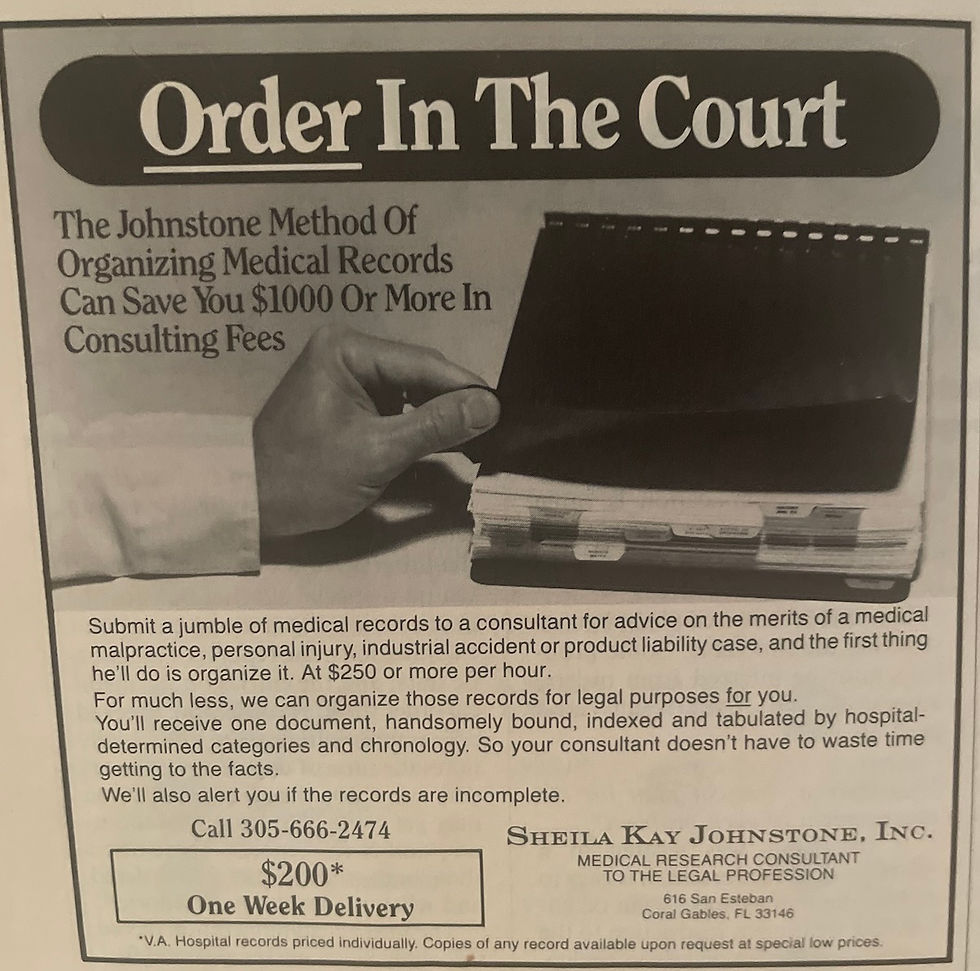
To serve smaller firms that could not afford her hourly rate, she built a second business, Order In The Court, that charged by the project. She staffed it with medical records librarians who organized and audited files, catching missing X-rays and incomplete charts before a case reached deposition.
She placed an ad for Order In The Court in the American Bar Association journal. She never placed another. Word traveled faster than any ad could.
None of it, she says, would have happened without mentors like Colson who recognized her potential before she even had a framework for it. Throughout her career, people invested in her growth, and she proved worthy of that investment through a simple, relentless rule: She refused to gloss over what she didn’t understand, choosing instead to master it.
Johnstone’s science colleagues were never surprised that she was also a dancer, a duo pianist, a fashion designer, and a cookbook author. Her arts friends, by contrast, struggled to reconcile the woman they knew with a molecular biologist. Johnstone never saw a divide.
The skills were the same: precision, detail, awareness, and the ability to recognize what had been left unsaid.
Professionalism was nonnegotiable, particularly as a woman working alongside attorneys at a time when she was often the only woman at the table. Colson told her to keep her guard up. She did.
“Watch how the person treats the waiter,” he told her. “That is the person you are working with.”
She was not immune to harder lessons. A financial accounting course became one of the most valuable things she studied. When her first accountant, widely recommended by other women in business, began stealing from her, she caught it herself. Others did not take it well. They liked him. Years later, his photograph appeared on the front page of the Miami Herald. His actions had caught up with him.
After relocating to Houston, Johnstone frequently lectured at the University of Houston Law Center, served on the Health Law & Policy Institute board, and spent nine years on the mayor’s council, contributing to international trade and development initiatives. She retired in 2015, but one chapter she had been quietly writing for decades was just beginning.
The Language That Looks Like Dancing
The woman who spent her career as an interpreter between medicine and law eventually found her way to a different kind of interpretation.
Johnstone’s interest in American Sign Language (ASL) began in the 1960s, at a lab window at Washington University School of Medicine, where she could see students at the adjacent Central Institute for the Deaf. Watching them sign, she thought it looked like hands that were dancing. The image never left her.
Decades later, she studied ASL formally at Concordia Seminary in St. Louis and earned the language’s highest proficiency level (ASL 5). After moving to Houston, she discovered Career and Recovery Resources, a nonprofit focused on helping people overcome barriers to stability. There she met ASL interpreters Kareena Heath and Kathy Adegboye, whom she credits with teaching her how to teach ASL. She also drew on her English degree, working with deaf students on English as a second language.

Sheila Johnstone: Dedicated ASL Instructor
Her Houston teaching expanded in 2013 through a partnership with Be An Angel, a north Houston nonprofit serving children with special needs. A now long-time friend, Richard Tyler, a prior Be An Angel board member, introduced Johnstone to the nonprofit and helped establish the partnership. After the Houston Chronicle covered that collaboration, her class filled immediately, and a waiting list formed. Students asked for more, so she added ASL 2 and ASL 3. Additional partnerships followed, including one with NewSpring, a faith-based organization dedicated to social and economic impact in the Spring Branch area.
Johnstone's classes are now held at Emerson Unitarian Universalist Church, 1900 Bering Dr. in Houston.
Her students include parents and grandparents of deaf children, physicians, attorneys, chaplains, teachers, and Houston police officers. She pursued Texas Commission on Law Enforcement (TCOLE) certification so officers could earn continuing education credits at no charge to them.
“I’m always running into people who tell me they took this class and are now able to speak with their 5-year-old grandson,” she says. “My classes are free, but they’re worth their weight in gold.”
For details about Johnstone's classes, call 713-443-8895.
About Copybrighters
Copybrighters is a ghostwriting studio that provides writing and editing support for businesses and nonprofits.
Our team includes experienced journalists, PR professionals, and marketers who know how to capture each client’s voice, message, and expertise.
We created The Spotlight™ to highlight remarkable individuals and demonstrate how strategic storytelling builds connection, trust, and lasting impact.
If your organization needs expert help telling its story, we’d be glad to help. Contact Copybrighters for a free consultation.


Comments